
Third-Party Certification for Dog Treats: A Step-by-Step Guide
Table of Contents
- What Third-Party Certification Means for Dog Treats
- How to Verify Pet Food Certifications on Treat Labels
- USDA Organic Dog Treats and What the Certification Guarantees
- Third-Party Food Safety Certification and Testing Standards
- Understanding Dog Treat Certification Labels and Claims
- Key Certifications for Dog Treats: Standards That Matter
- Choosing the Right Certification for Your Dog's Needs
- Frequently Asked Questions
Last Updated: October 18, 2026
What Third-Party Certification Means for Dog Treats
Third party certification for dog treats is an independent verification that confirms a product meets specific safety, quality, and ingredient standards set by regulatory bodies or industry organizations. Unlike manufacturer claims alone, third-party certification involves external audits, testing, and ongoing compliance monitoring. This means an unbiased organization has inspected the facility, reviewed the ingredient sourcing, and validated that the treats contain what the label says they contain.
For pet owners, third-party certification provides peace of mind. It's the difference between trusting a label and knowing a product has been verified by someone with no financial stake in the sale. At Dog Mamma's, we believe this transparency matters, which is why our treats carry USDA Organic certification, a rigorous third-party validation that requires annual audits and strict compliance with federal organic standards.
Third-party certification typically covers several areas:
- Ingredient verification: Confirms all ingredients are sourced as claimed
- Manufacturing practices: Audits facility cleanliness, equipment, and food safety protocols
- Labeling accuracy: Ensures claims match actual product composition
- Contamination testing: Tests for harmful pathogens, pesticides, and heavy metals
- Traceability: Documents the supply chain from farm to finished treat
The certification process isn't quick or cheap. It requires documentation, facility inspection, product testing, and annual renewal. But that investment signals genuine commitment to quality, not just marketing language.
How to Verify Pet Food Certifications on Treat Labels
Verifying a certification on a dog treat package requires knowing what to look for and where to look. Many pet parents see a seal or logo and assume it's legitimate, but not all claims are equally rigorous. Here's how to spot the real thing.
First, check for the certification body's name and logo on the package. Legitimate certifications always display the certifier's contact information or website. Search for that organization online and verify they actually exist and operate in the pet food space. If you can't find the certifier's website or they don't list their standards publicly, that's a red flag.
Next, look for specific language about what the certification covers. Does it verify organic ingredients only, or does it also cover manufacturing practices and contamination testing? A comprehensive certification addresses multiple areas, ingredient sourcing, facility audits, and food safety testing. Single-focus certifications (like ingredient verification alone) are legitimate but narrower in scope.
Ask yourself these questions when evaluating a certification claim:
- Is the certifier an independent third party, or is it affiliated with the manufacturer?
- Does the certification body publish their standards publicly?
- Can you find the product listed on the certifier's directory?
- Does the package include a certification number or date of last audit?
Many certifiers maintain searchable databases where you can verify that a specific product is actually certified. For example, USDA Organic certified products can be looked up through the USDA's organic integrity database. If a product claims certification but doesn't appear in the official registry, that's a sign the claim may be misleading.
USDA Organic Dog Treats and What the Certification Guarantees
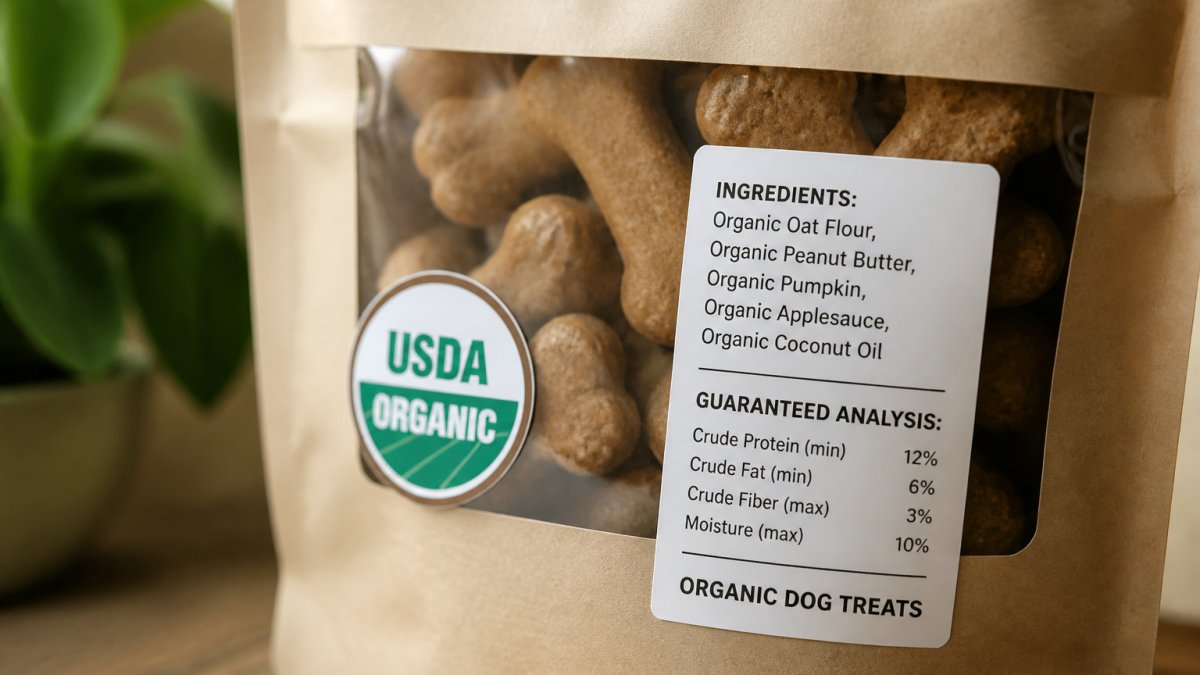
USDA Organic certification is one of the most stringent standards available for dog treats. It guarantees that ingredients are grown without synthetic pesticides, artificial fertilizers, GMOs, or antibiotics. But understanding what the certification actually covers helps you make informed choices for your dog.
USDA Organic certification means:
- No synthetic pesticides: Ingredients must be grown without conventional chemical pesticides
- No GMOs: All ingredients are non-genetically modified
- No artificial additives: No synthetic preservatives, colors, or flavors
- Sustainable farming practices: Producers must maintain soil health and biodiversity
- Annual audits: Certified operations are inspected yearly to ensure ongoing compliance
- Traceability: Every ingredient is tracked from farm through processing
What USDA Organic does NOT guarantee:
- It doesn't verify that treats are "complete and balanced" nutrition
- It doesn't test for all contaminants or heavy metals
- It doesn't address allergen risks or cross-contamination
- It doesn't mandate specific protein levels or nutrient profiles
For dogs with sensitive stomachs or allergies, USDA Organic certification eliminates one major concern, pesticide residues and synthetic chemicals. But it doesn't replace the need to check the ingredient list itself.
The certification process requires annual facility audits and documentation of all ingredient sources. Manufacturers must maintain detailed records showing where each ingredient came from and how it was handled. This traceability is valuable if a contamination issue ever arises, auditors can trace the problem back to its source.
Dog Mamma's treats carry USDA Organic certification, which means every organic ingredient in our recipes has been verified to meet federal organic standards. This certification reinforces our commitment to clean, pesticide-free nutrition for your dog.
Third-Party Food Safety Certification and Testing Standards
Third party certification for dog treats in the food safety category goes beyond ingredient verification. It involves testing for harmful pathogens, contamination, and manufacturing hygiene. For dog treats, this means audits of the production facility, testing of finished products, and documentation of food safety protocols.
Common food safety certification standards for pet food include HACCP (Hazard Analysis and Critical Control Points) compliance. HACCP is a systematic approach to food safety that identifies potential hazards and establishes critical control points where risks can be prevented or reduced (the FDA). A facility with HACCP certification has documented procedures for monitoring temperature, sanitation, ingredient handling, and finished product testing.
Third-party food safety certification typically involves:
- Facility inspection: Auditors evaluate equipment, sanitation, employee practices, and storage conditions
- Pathogen testing: Products are tested for common contaminants like salmonella and E. coli
- Traceability audits: Records are reviewed to ensure ingredients can be traced back to their source
- Documentation review: All safety procedures and testing results are verified
- Follow-up audits: Ongoing compliance is monitored through unannounced inspections
When a facility passes third-party food safety certification, it signals that the manufacturer takes contamination prevention seriously. This is especially important for treats marketed to dogs with sensitive digestive systems or immune sensitivities.
Dog Mamma's treats are handcrafted and our production practices protect your dog's health, ensuring our treats are manufactured safely from start to finish.
Understanding Dog Treat Certification Labels and Claims
Certification labels can be confusing because not all of them carry the same weight. Some certifications are voluntary and industry-led, while others are regulated by government agencies. Understanding the difference helps you make sense of what you see on packaging.
Government-backed certifications like USDA Organic are the most heavily regulated. These involve federal oversight, mandatory audits, and legal consequences for fraud. If a product falsely claims USDA Organic certification, the manufacturer can face fines and legal action.
Industry certifications vary widely in rigor. Some are developed by trade associations and require rigorous third-party audits. Others are self-policing and less stringent. When evaluating an industry certification, ask:
- Who developed the standard?
- Is certification awarded by an independent third party?
- What does the certification actually verify?
- How often are audits conducted?
Label claims like "natural," "premium," or "wholesome" are often unregulated marketing language. They don't necessarily indicate third-party verification. In contrast, specific certifications like "USDA Organic," "Non-GMO Project Verified," or "Certified Humane" involve documented verification by external organizations.
Dog Mamma's Organic Peanut Butter Banana Recipe - USDA Organic Certified Dog →
Watch for misleading label language. A treat labeled "made with organic ingredients" might contain only a small percentage of organic components, the rest could be conventional. True USDA Organic certification requires that at least 95% of ingredients be organic.
The certification label itself should include:
- The certifier's name and logo
- A certification number or code
- The date of certification or expiration
- Contact information for the certifying body
If any of these elements are missing, the claim is incomplete and should raise questions.
Key Certifications for Dog Treats: Standards That Matter
Several certifications are particularly relevant for dog treats. Understanding what each one verifies helps you choose treats aligned with your priorities.
USDA Organic Certification verifies that ingredients meet federal organic standards. This is the most rigorous certification available and requires annual audits.
Non-GMO Project Verified confirms that ingredients are not genetically modified. This certification is valuable for owners concerned about GMO exposure but doesn't address pesticide use or other aspects of ingredient quality.
Certified Humane focuses on animal welfare standards in ingredient sourcing. If a treat contains meat or animal-derived ingredients, this certification verifies that animals were raised humanely.
Food Safety Certifications like HACCP compliance or third-party pathogen testing verify manufacturing safety.
Allergen-Free Certifications verify that treats are manufactured in facilities free from specific allergens. This is valuable for dogs with severe allergies or sensitivities.
Small-Batch or Artisan Certifications are less common but sometimes used to verify that treats are produced in limited quantities with minimal processing. These certifications vary in rigor and should be evaluated individually.
The most valuable certifications combine multiple verification areas. A treat with USDA Organic certification plus food safety testing plus transparent ingredient sourcing offers comprehensive assurance.
Choosing the Right Certification for Your Dog's Needs
Not every certification matters equally for every dog. Your choice depends on your dog's health, your priorities, and what claims matter most to you.
For dogs with sensitive stomachs: Prioritize USDA Organic certification and food safety testing. These verify that ingredients are pesticide-free and that the facility follows strict contamination prevention protocols.
For dogs with allergies: Look for allergen-free certifications or facility certifications that verify the treat is manufactured in an allergen-controlled environment. This prevents cross-contamination from other products made in the same facility.
For owners prioritizing sustainability: USDA Organic certification includes sustainable farming requirements, so this is a good baseline.
For active or sport dogs: High-protein treats may carry different certifications than standard treats.
For budget-conscious pet parents: Not every dog needs every certification. If your dog has no known sensitivities, a treat with basic third-party food safety verification may be sufficient.
When choosing a treat, start with your dog's health profile. Does your dog have sensitivities or allergies? Does your dog need specific nutritional support?
Ask manufacturers directly about their certifications and what each one verifies. Reputable producers are transparent about their verification processes and happy to explain why they chose specific certifications.
Choosing certified dog treats gives you confidence that you're feeding your dog quality nutrition backed by independent verification. Dog Mamma's USDA Organic Certified treats like our Organic Berry Banana Coconut Recipe provide that verified quality, giving your dog clean, pesticide-free nutrition in every bite.

Frequently Asked Questions
What does third-party certification mean for dog treats?
Third-party certification means an independent organization audits and verifies that a dog treat manufacturer meets specific safety, quality, and ingredient standards. The certifier is separate from the manufacturer, ensuring unbiased verification. This validation covers manufacturing practices, ingredient sourcing, facility cleanliness, and testing for contaminants. Third-party certification provides consumers confidence that label claims are backed by verification, not just company promises.
How can I verify a dog treat certification claim?
Check the treat's packaging for the certification seal or logo. Visit the certifying organization's website and search their directory of certified products and manufacturers. Request documentation from the brand showing their current certificate and audit results. For USDA Organic, search the USDA Organic Integrity Database. Ask the manufacturer directly for their certification number and renewal date. Legitimate certifications are recent, specific to the product, and verifiable through the certifier's public records.
Does USDA Organic certification apply to dog treats?
Yes, USDA Organic certification applies to dog treats made with organic ingredients. The USDA Organic standard requires that treats contain at least 95% certified organic ingredients, prohibits synthetic pesticides and GMOs, and mandates facility inspections. However, not all dog treats carry this certification. USDA Organic certification for pet treats follows the same rigorous standards as human food, ensuring ingredient quality and manufacturing safety.
What certifications should I look for on dog treat labels?
Look for USDA Organic if you want pesticide-free, non-GMO treats. For food safety, seek third-party verification from recognized auditors. Check for certifications verifying ingredient sourcing and humane animal welfare practices. Review the label for the certifier's name, logo, and certification number. Avoid vague terms like 'natural' or 'premium' without backing certification. Legitimate certifications are specific, recent, and traceable to an independent verifying body.