
Best Organic Dog Treats 2026: Top Picks Reviewed
Table of Contents
- Best Organic Dog Treats 2026: Quick Comparison
- Dog Mamma's Organic Peanut Butter Banana Recipe
- Dog Mamma's Organic Berry Banana Coconut Recipe
- Dog Mamma's Organic Sweet Potato & Kale Recipe
- Dog Mamma's Organic Apple Cranberry Recipe
- USDA Organic Dog Treat Certification Requirements
- How to Read Dog Treat Labels for Hidden Additives
- Benefits of Human-Grade Dog Treats
- Frequently Asked Questions
Last Updated: October 9, 2026
Best Organic Dog Treats 2026: Quick Comparison
Finding the best organic dog treats in 2026 starts with one question: does the label prove what it claims? At Dog Mamma's, we bake small-batch, USDA Organic Certified, plant-based treats because "natural" means almost nothing without third-party verification. This guide ranks our four recipes, explains what USDA Organic certification requires, and shows you how to spot hidden additives.
Here's how our four crunchy recipes compare:
| Recipe | Key Ingredients | Best For |
|---|---|---|
| Peanut Butter Banana | Organic peanut butter, organic banana | Picky eaters, training rewards |
| Berry Banana Coconut | Organic blueberries, banana, coconut | Antioxidant support |
| Sweet Potato & Kale | Organic sweet potato, organic kale | Sensitive stomachs |
| Apple Cranberry | Organic apple, cranberry, cinnamon | Everyday snacking |
Dog Mamma's Organic Peanut Butter Banana Recipe
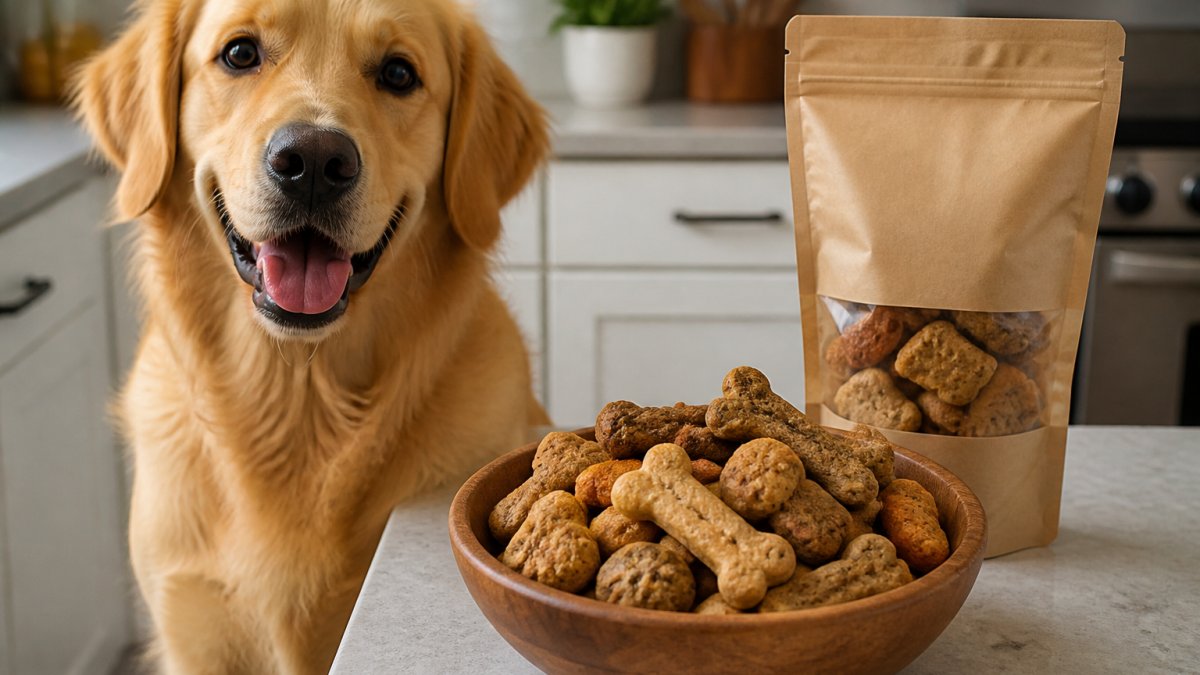
Our Peanut Butter Banana recipe leads the lineup for one reason: dogs rarely turn it down. Each 6 oz bag is baked with creamy organic peanut butter and sweet organic bananas, then hand-packed in small batches.

At $10.49 per bag, that price reflects the certification behind it, not marketing. USDA Organic certification requires annual third-party inspection of every ingredient source and production facility, a step most treats labeled "natural" skip entirely. If other organic brands still caused digestive upset, the ingredient list is short, and peanut butter and banana are low-risk for most dogs.
Dog Mamma's Organic Berry Banana Coconut Recipe
Blueberries do the heavy lifting here. Each treat contains whole organic blueberries you can actually see, plus sweet organic banana and crispy organic coconut flakes with a dash of cinnamon. Blueberries are a well-known source of antioxidants.
The coconut adds texture rather than flavor. Like every Dog Mamma's recipe, it's plant-based, non-GMO, and free from pesticides and synthetic preservatives. If your dog is new to coconut, introduce this treat slowly over a few days.
Dog Mamma's Organic Sweet Potato & Kale Recipe
Sweet potato and kale make this the most nutritionally dense recipe in the lineup. The sweet potato provides gentle fiber, while jumbo pieces of dark green leafy organic kale deliver superfood nutrition. For dogs with sensitive stomachs or allergies to chicken, beef, or dairy, this is a tasty combination of Organic Sweet Potato and Super Food Organic Kale.

Dog Mamma's Organic Apple Cranberry Recipe
Apple and cranberry give this recipe a wholesome blend of sweet Organic Apples, tart, juicy Organic Cranberries and a dash of Organic Cinnamon for a taste that is just like homemade apple pie!
Cranberries are often included in dog treats for urinary tract support, though no single ingredient is a cure. The cinnamon amount is safe for dogs, but check with your vet before making it a daily habit if your dog is on medication.
USDA Organic Dog Treat Certification Requirements
USDA Organic certification for dog treats is not a marketing label. It is a legal standard enforced under the USDA National Organic Program, and it requires that at least 95% of ingredients by weight be certified organic. Meeting that bar means every farm supplying ingredients must be inspected, synthetic pesticides and fertilizers are prohibited, and GMO ingredients are banned outright. Producers also pay for annual third-party audits and maintain traceability records from farm to finished bag. You can review the full rule set through the USDA National Organic Program.
The four label tiers, and what each one actually proves
The word "organic" on a pet treat package is not one claim. It is four different claims with four different thresholds, and only one of them earns the seal:
| Label wording | Organic content required | USDA seal allowed? |
|---|---|---|
| "100% Organic" | 100% organic ingredients (excluding water and salt) | Yes |
| "Organic" | At least 95% organic ingredients by weight | Yes |
| "Made with Organic [ingredient]" | At least 70% organic ingredients | No |
| "Natural," "holistic," "wholesome" | No defined organic threshold | No |
That last row is the one that costs pet owners money. "Natural" is a looser claim with no organic content requirement, and "holistic" has no regulatory definition for pet treats at all. A bag can lead with a pastoral farm illustration, say "natural" three times, and contain zero certified organic ingredients.
How to verify a seal in about two minutes
A seal printed on a bag is a claim, not proof. Verification takes three steps:
- Look for the specific seal. The USDA Organic seal is a circle with the words "USDA ORGANIC" and a green-and-white color scheme. Lookalike logos with leaves, sunrises, or the word "organic" in a similar font are not the seal.
- Find the certifier. Certified operations are required to identify their USDA-accredited certifying agent on the package, often in small print near the ingredient panel or the lot code. A certifier name is a strong signal; its absence on a product claiming organic is a red flag.
- Search the certifier's directory. Every accredited certifier publishes a list of operations it certifies. If the brand name does not appear, the claim does not hold up.
A common pattern: a package saying "made with organic oats" in large type and "natural" on the front panel. That product may contain as little as 70% organic content and cannot legally carry the seal, not fraudulent, but a weaker claim than most shoppers assume.
Why certified organic treats cost more
Certification adds real cost at every step: inspection fees, record-keeping labor, segregated storage and transport to prevent commingling with conventional ingredients, and yield losses on farms that cannot use synthetic inputs. That's why genuinely certified organic dog treats sit above conventional ones on the shelf. When a bag says "natural" or "holistic" with no seal, no independent body verifies anything, look for the USDA Organic seal specifically, not a lookalike logo.
How to Read Dog Treat Labels for Hidden Additives
Reading a dog treat label comes down to four checks: the certification seal, ingredient order, preservatives, and the sourcing statement. The first ingredient listed is present in the highest quantity by weight, so a bag leading with "wheat flour" is mostly filler regardless of front-of-package claims.
Dog Mamma's Organic Peanut Butter Banana Recipe - USDA Organic Certified Dog →
Watch for these common additives:
- BHA, BHT, and ethoxyquin, synthetic preservatives linked to health concerns in long-term feeding studies
- Propylene glycol, a humectant used to keep soft treats moist
- Artificial colors, added purely for human appeal, never for the dog
- "Natural flavor", an umbrella term that can hide dozens of undisclosed compounds
- Added sugars and syrups (corn syrup, molasses, glycerin used as a sweetener rather than a humectant), which push calorie density up without adding nutrition
A side-by-side organic comparison method
Compare products only on verified organic status and the four label checks above, scoring each candidate on this grid:
| Check | What a strong answer looks like | What a weak answer looks like |
|---|---|---|
| Certification | USDA Organic seal plus a named certifier | "Natural" or a lookalike logo |
| First three ingredients | Recognizable whole foods, named proteins or produce | Flour, starch, or "meal" first |
| Preservatives | Tocopherols, rosemary extract, or none listed | BHA, BHT, ethoxyquin, propylene glycol |
| Sourcing | Brand publishes origin or supplier standards | No sourcing information anywhere |
| Calorie disclosure | kcal per treat or per oz on the label or site | No calorie data at all |
Run every candidate through the same grid and the comparison stops being about packaging.
Sourcing and traceability: the question most labels dodge
Ingredient sourcing is the harder question. A label rarely tells you where the chicken or sweet potato came from, and "made in a facility that also processes" language says nothing about origin. Certified organic products are the exception: the certification trail requires documented sourcing from farm to finished bag.
A practical test when comparing two brands: ask where the primary protein or produce is sourced, and which certifier audits the facility.
Fitting treats into your dog's daily calories
Treats should generally stay within about 10% of a dog's daily calorie intake, with the rest from a complete and balanced diet. Here's how to apply that:
- Find your dog's daily calorie target. Your veterinarian can give you a number based on weight, age, and activity level. As a rough starting point, many adult dogs in the 20 to 50 pound range land somewhere between 400 and 900 kcal per day, but individual needs vary widely.
- Calculate the 10% treat budget. If your dog's target is 600 kcal per day, the treat budget is about 60 kcal.
- Divide by the treat's calorie content. If a treat is 15 kcal, that is roughly four treats per day. If it is 40 kcal, it is one and a half.
- Adjust for training days. On a heavy training day, break each treat into quarters. Four pieces of a 15 kcal treat become sixteen rewards for the same 60 kcal budget.
This is why "low-calorie" on a package isn't a useful comparison on its own. A soft, moist treat can carry several times the calories of a small crunchy one, and six a day can be a meaningful share of your dog's daily needs. Check the kcal figure before the flavor.
The FDA's guidance on pet food labeling is worth reading if you want to understand exactly what current regulations do and don't require on a treat package.
Benefits of Human-Grade Dog Treats
Human-grade dog treats are made from ingredients meeting the same safety standards as human food, produced in facilities held to human food regulations rather than feed-grade rules.
The practical difference is what's excluded. Feed-grade supply chains permit ingredients and handling practices that human food rules prohibit, including certain rendered proteins and higher contaminant levels. Human-grade production costs more, hence the higher price point.
For pet owners managing allergies or digestive sensitivities, that gap matters. The FDA's guidance on pet food labeling is worth reading if you want to understand exactly what current regulations do and don't require on a treat package.
Frequently Asked Questions
What makes a dog treat officially USDA Organic?
A treat earns USDA Organic certification when at least 95% of its ingredients are certified organic and the product meets federal production, handling, and labeling standards. The facility must be inspected by a USDA-accredited certifying agent, and the product must carry the USDA Organic seal on packaging. Dog Mamma's holds this certification across its entire treat line, so you can verify the claim directly on the bag.
How do I read dog treat labels for hidden additives?
Start with the ingredient list: it should name recognizable whole foods like organic peanut butter, bananas, or sweet potato, not vague terms such as 'meat meal' or 'natural flavoring.' Watch for preservatives (BHA, BHT, ethoxyquin), artificial colors, and added sugars. If a label says 'natural' without a USDA Organic seal, the claim is largely unregulated.
Are organic dog treats actually healthier for pets?
Organic treats reduce your dog's exposure to synthetic pesticides, GMOs, and certain preservatives banned under USDA Organic rules. For dogs with food sensitivities or allergies, fewer synthetic additives can mean fewer digestive upsets. That said, organic is not a substitute for a balanced diet. Treats should make up no more than 10% of daily calories. Choose organic when you want cleaner ingredients and verified sourcing.
What are the benefits of human-grade dog treats?
Human-grade means every ingredient and the finished product meet federal standards for human food production. That translates to stricter sourcing, cleaner facilities, and no feed-grade fillers. For pet owners, the benefits of human-grade dog treats include better digestibility, fewer mystery ingredients, and greater confidence in what your dog is actually eating. Dog Mamma's bakes its treats in small batches using human-grade, plant-based ingredients.
Are plant-based organic treats safe for all dog breeds?
Plant-based treats are safe for most dogs. Dogs are omnivores and can digest plant proteins like peanut butter and pea protein. However, dogs with specific protein allergies should always try a new treat in small amounts first. If your dog has a diagnosed health condition, check with your veterinarian before switching. Dog Mamma's treats use organic fruits, vegetables, and plant proteins.