
How to Choose the Best Organic Crunchy Dog Treats
Last Updated: November 1, 2026
Quick Summary
The best organic crunchy dog treats are baked biscuits made with ingredients grown and processed under USDA organic rules, which restrict synthetic pesticides, added hormones, and genetic engineering. Verify the USDA seal and named certifier in the USDA Organic Integrity Database, and check that the ingredient panel attaches organic to specific ingredients. Keep treats to about 10% of your dog's daily calories.
- The USDA organic label has four categories, and Organic requires at least 95% certified organic ingredients by weight.
- Natural and non-GMO claims are separate from organic and say nothing about pesticide use or farming practices.
- Avoid biscuits with artificial colors, flavors, BHA, BHT, ethoxyquin, or added salt.
- A 5-gram biscuit at 3,500 kcal/kg works out to about 17.5 kcal per piece.
- All four Dog Mamma's recipes come in 6 oz bags priced at $10.49.
Table of Contents
- Why Organic Crunchy Dog Treats Are Worth the Label Check
- How to Verify USDA Organic Dog Treats Before You Buy
- Dog Treat Ingredients to Avoid in Crunchy Biscuits
- The Best Organic Dog Treats for Sensitive Stomachs and Allergies
- Crunchy Texture, Dental Health, and What Biscuits Can and Cannot Do
- How Many Treats Can Dogs Have Per Day?
- Comparing Dog Mamma's Organic Crunchy Treat Recipes
- Stock Your Treat Jar with a USDA Organic Crunchy Recipe
- Frequently Asked Questions
Why Organic Crunchy Dog Treats Are Worth the Label Check
Walk down any pet aisle and you'll find bags shouting "natural," "wholesome," and "real ingredients." Few of those words are regulated. Organic is different, and that's exactly why the best organic crunchy dog treats for dogs deserve a closer look than the average biscuit.
At Dog Mamma's, we bake small-batch, plant-based biscuits and hold USDA Organic certification on the bag. A review of dog treat science in Frontiers in Animal Science notes that meat snacks remain the most popular treat type among owners, which means plant-based biscuits are still the road less traveled.
How to Verify USDA Organic Dog Treats Before You Buy
Verification starts with the seal, not the marketing copy. A genuine USDA Organic claim on a pet treat package means the product was produced under the USDA National Organic Program, and the seal should appear with the certifying agent's name on the package. For proof that a specific brand's claim is real, see Dog Mammas Achieves Usda Organic Certification. If a bag says "organic" in big letters but carries no seal and no certifier, treat the claim as unproven.
The USDA organic label is not one claim, it is four distinct categories, and each one means something different on a dog treat bag:
| Label Claim | What It Requires | What It Means for a Treat |
|---|---|---|
| "100% Organic" | All ingredients certified organic (excluding water and salt) | The strictest claim; rare in baked biscuits because minor ingredients are hard to source organically |
| "Organic" | At least 95% of ingredients certified organic by weight | The claim most certified biscuits carry; up to 5% of ingredients may be non-organic but must be on the allowed list |
| "Made with Organic [ingredient]" | At least 70% certified organic ingredients | A meaningful but weaker claim; up to 30% of the product can be non-organic |
| "Organic" in brand name or marketing copy only | No certification required | Unverified; treat as a marketing word, not a standard |
Reading the USDA Seal and Ingredient Panel
Flip the bag over. The ingredient panel tells you what's actually inside, listed by weight. Look for the word "organic" attached to specific ingredients, not just a front-of-pack badge. A bag that lists "organic oats, organic peanut butter, organic banana" is making a verifiable statement. A bag that lists "oats, peanut butter, banana" and calls itself organic on the front is not.
Two more label details separate a verified product from a vague one:
- The certifier's name. The USDA seal must be accompanied by the name of the USDA-accredited certifying agent that inspected the facility. That name is your lookup key.
- The facility statement. Look for "certified organic by [certifier]" or "processed in a USDA-certified organic facility." A product can be made with organic ingredients in a facility that is not itself certified, that is a different level of assurance.
How to Look Up a Certifier and Confirm the Claim
The USDA maintains a public directory of accredited certifying agents through the National Organic Program. If a bag names a certifier you do not recognize, search that certifier and the manufacturer in the USDA Organic Integrity Database, which lists certified operations by product category. A legitimate certifier will appear there, and the operation that baked the treats should be listed under a pet-treat or processed-food category.
A practical verification sequence:
- Confirm the USDA seal is present and the certifier is named.
- Search the certifier and the manufacturer in the USDA Organic Integrity Database.
- Check that the ingredient panel attaches "organic" to specific ingredients, not just the front panel.
- Confirm the label category, "100% Organic," "Organic," or "Made with Organic", matches what the front of the bag implies.
Organic, Natural, and Non-GMO Are Not the Same Claim
"Natural" has no formal regulatory definition for pet treats beyond general labeling expectations, and "non-GMO" is a separate verification that says nothing about pesticide use or farming practices. A treat can be non-GMO and still be grown with synthetic pesticides; it can be called "natural" and contain synthetic preservatives. Only the USDA organic seal ties together restrictions on synthetic pesticides, added hormones, genetic engineering, and sewage-sludge-based fertilizer under one inspected standard.
Dog Treat Ingredients to Avoid in Crunchy Biscuits
The ingredient list is where most "healthy" biscuits quietly fall apart. Watch for artificial colors, artificial flavors, and preservatives like BHA, BHT, and ethoxyquin. None of these belong in a biscuit you hand over daily. Added salt is another one to scan for, since many dogs get plenty from their regular food.
Artificial Colors, Flavors, and Preservatives
Biscuits don't need to be bright red or neon green, that color usually comes from dye, not food. Synthetic preservatives extend shelf life but add nothing to your dog's nutrition. For the common names, see our breakdown of hidden synthetic preservatives in dog treats.
A practical checklist for the label:
- Certified organic seal present with a named certifier
- No artificial colors or flavors
- No BHA, BHT, or ethoxyquin
The Best Organic Dog Treats for Sensitive Stomachs and Allergies
Dogs with food sensitivities need fewer variables, not more. A short, plant-based ingredient list removes common protein triggers and makes it easier to spot what agrees with your dog. For a fuller guide to picking treats for dogs with sensitive stomachs, see Best Dog Treats for Sensitive Stomachs.
Our Peanut Butter Banana and Sweet Potato & Kale recipes are both plant-based and USDA Organic certified, which keeps the ingredient panel short and readable.
Crunchy Texture, Dental Health, and What Biscuits Can and Cannot Do
Crunchy biscuits give dogs who like something firm to bite a texture to chew. What they cannot do is replace dental care. A biscuit does not brush a tooth, and no treat removes established tartar.
Dog Mamma's Organic Peanut Butter Banana Recipe - USDA Organic Certified Dog →
Texture also affects palatability and digestibility. Some dogs gulp soft treats; a firmer biscuit slows eating slightly. If your dog has dental pain, missing teeth, or a history of gulping treats whole, soften the biscuit or choose a smaller piece.
How Many Treats Can Dogs Have Per Day?
Treats should stay a small slice of the daily diet, not a meal replacement. A common guideline among veterinarians and pet nutritionists is to keep treats to no more than about 10% of a dog's daily calories, then adjust the main meal if the treat load grows. The math matters more than the rule of thumb, because "one or two biscuits" means very different things depending on the biscuit.
Doing the 10% Math
Start with your dog's daily calorie target. A resting-energy estimate for a typical inactive dog is roughly 30 calories per pound of body weight per day, adjusted up for activity and down for weight loss. That gives a treat budget:
| Dog Size | Approx. Daily Calories (maintenance) | 10% Treat Budget |
|---|---|---|
| Small (10 lb) | ~300 kcal | ~30 kcal |
| Small (under 20 lb) | ~450-600 kcal | ~45-60 kcal |
| Medium (20-50 lb) | ~600-1,200 kcal | ~60-120 kcal |
| Large (over 50 lb) | ~1,200-1,800 kcal | ~120-180 kcal |
Those are estimates, not prescriptions. Your veterinarian can give you a target based on body condition score, age, and health status. The point is that the treat budget is a number you can count against, and the calorie count per treat is the piece most owners never check.
Calories per Treat: Read the Bag, Then Weigh It
Calorie content on a pet treat label is usually expressed as kilocalories per kilogram (kcal/kg) or per treat, following the same labeling conventions used for complete pet foods. To compare biscuits fairly, convert to calories per piece:
- Find the kcal/kg figure on the guaranteed analysis or the feeding guide.
- Weigh one treat on a kitchen scale in grams.
- Multiply: (kcal/kg ÷ 1,000) × treat weight in grams = kcal per treat.
A biscuit that weighs 5 grams at 3,500 kcal/kg works out to about 17.5 kcal per piece. At that rate, a 10 lb dog on a 30 kcal treat budget gets one or two pieces a day, not a handful. A 60 lb dog on a 120 kcal budget can afford several, but the same biscuit still adds up across a training session.
Treat Load by Dog Size
| Dog Size | Typical Treat Load | Watch For |
|---|---|---|
| Small (under 20 lb) | 1-2 small pieces daily | Weight creep from training rewards; break pieces in half |
| Medium (20-50 lb) | 2-4 pieces daily | Meal portions staying too large |
| Large (over 50 lb) | 3-5 pieces, split up | Gulping whole biscuits |
Weight Management and Low-Calorie Choices
If your dog is on a weight-loss plan, the treat budget shrinks with the calorie target, often to 10% of a reduced-calorie diet, which can mean a single small biscuit or a few broken pieces. Treat selection matters as much as portion size: a lower-calorie biscuit per gram lets you reward more often. Compare kcal/kg across products rather than assuming a "light" biscuit is automatically lower.
Puppies, Seniors, and Dogs on Veterinary Diets
Puppies need calorie-dense food for growth, so treats should be small and infrequent enough not to displace complete puppy food. Senior dogs and dogs on prescription or veterinary therapeutic diets, for kidney, urinary, cardiac, or endocrine conditions, should have treats cleared with their veterinarian, because some biscuits carry mineral or protein loads that conflict with a therapeutic diet. Feeding guidelines on the bag are a starting point, not a rule.
Comparing Dog Mamma's Organic Crunchy Treat Recipes
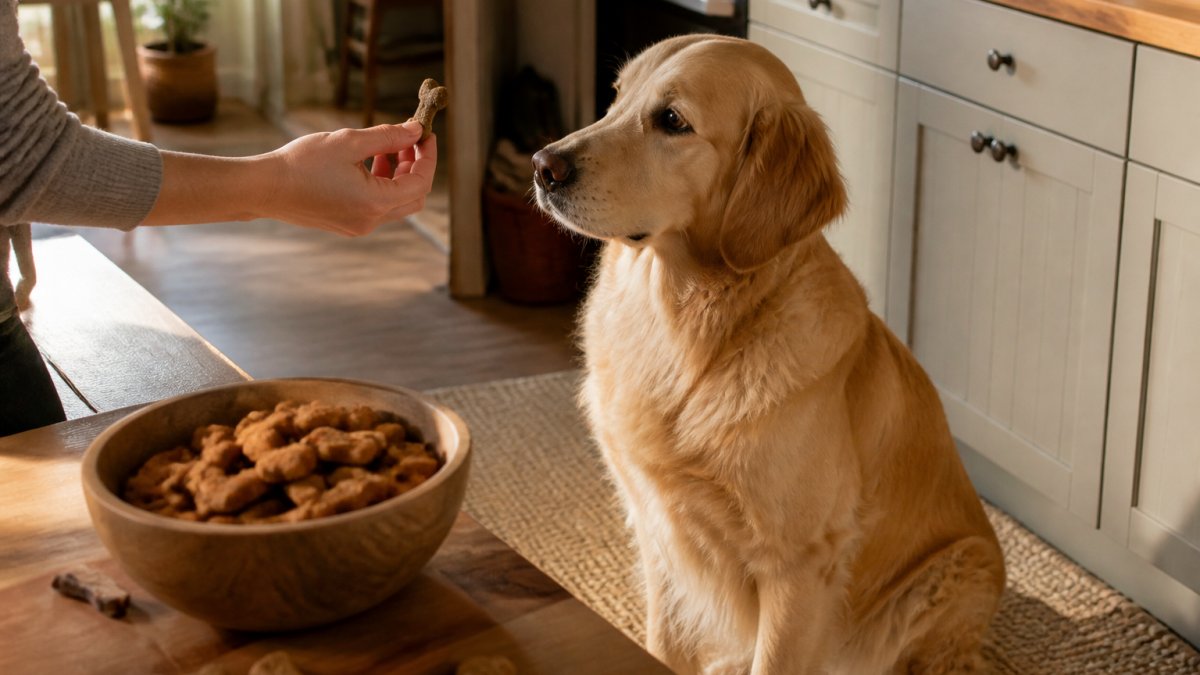
Four recipes, one format, and each one leans on a different flavor profile. All are baked crunchy, sold in 6 oz bags, and priced at $10.49.
| Recipe | Flavor Profile | Best For | Price |
|---|---|---|---|
| Peanut Butter Banana | Creamy peanut butter and sweet banana | Everyday rewards, peanut butter lovers | $10.49 |
| Berry Banana Coconut | Blueberry, banana, coconut, cinnamon | Fruity variety, antioxidant-rich fruit | $10.49 |
| Sweet Potato & Kale | Savory sweet potato and kale | Superfood-focused owners | $10.49 |
| Apple Cranberry | Apple, cranberry, cinnamon | A homestyle, pie-like flavor | $10.49 |
Stock Your Treat Jar with a USDA Organic Crunchy Recipe
Choosing well comes down to a few habits: check the seal, read the panel, match the recipe to your dog, and keep portions honest.


Dog Mamma's makes small-batch, human-grade, plant-based treats that are USDA Organic Certified, free from pesticides and GMOs. If you want clean rewards without a label full of question marks, browse our favorites and find the recipe your dog will sit for.
Frequently Asked Questions
Are organic crunchy dog treats better for dogs?
Organic crunchy dog treats are not automatically more nutritious than conventional ones, but the USDA Organic seal guarantees specific production standards: no synthetic pesticides, no GMOs, and no artificial colors or flavors. For owners worried about residue exposure or food sensitivities, that verification matters. Plant-based and organic options can offer a simpler ingredient panel for owners managing sensitivities. Always check the seal, not just the word organic on the front of the bag.
How can I tell if a dog treat is really USDA Organic certified?
Look for the USDA Organic seal printed on the package, then check the ingredient panel for the organic certification statement. Products labeled 100 percent organic must contain only organic ingredients; products labeled organic must be at least 95 percent organic by weight. A brand that says natural or made with organic ingredients without the seal has not been through the same third-party verification. Dog Mamma's carries the USDA Organic Certified seal on every recipe, so you can confirm certification before you buy.
How many treats can dogs have per day?
A common guideline is that treats should make up no more than 10 percent of a dog's daily calories, with the rest coming from a complete balanced diet. For a 25-pound dog eating roughly 700 calories a day, that means about 70 calories of treats. Small crunchy biscuits are usually low in calories, so a few pieces fit easily into that budget. Adjust portion size for training sessions, and reduce the main meal slightly on heavy reward days.
Are crunchy treats safe for puppies and senior dogs?
Most puppies over 12 weeks and healthy senior dogs can handle crunchy baked treats, but size and texture matter. Break larger biscuits into smaller pieces for small breeds and puppies, and watch senior dogs with missing teeth or dental disease. Crunchy treats can support oral care by encouraging chewing, but they are not a substitute for brushing or professional dental cleanings. If your dog has a history of splintering chews or swallowing pieces whole, choose a softer baked texture or soak the treat briefly.
Ready to upgrade the treat jar? Get started with Dog Mamma's and give your dog a crunchy, certified organic reward built on transparent sourcing and plant-based ingredients.
