
7 Best Eco Friendly Dog Treat Brands for 2026
Table of Contents
- What Makes a Dog Treat Brand Truly Eco-Friendly?
- Certifications and Claims That Actually Matter
- How We Evaluated These Eco Friendly Dog Treat Brands
- 1. Dog Mamma's: USDA Organic Certified Sustainable Dog Treats
- 2. Dog Mamma's Organic Peanut Butter Banana Recipe
- 3. Dog Mamma's Organic Berry Banana Coconut Recipe
- 4. Dog Mamma's Organic Sweet Potato & Kale Recipe
- 5. Dog Mamma's Organic Apple Cranberry Recipe
- Why Organic Dog Treats Are Worth the Investment
- Frequently Asked Questions
Last Updated: October 12, 2026
What Makes a Dog Treat Brand Truly Eco-Friendly?
An eco-friendly dog treat brand reduces environmental impact across the entire product lifecycle, from ingredient sourcing and farming to production and packaging disposal. That definition matters because "eco-friendly" has no single legal standard in the pet food industry, so the label alone tells you very little.
We built this guide at Dog Mamma's after years of watching pet parents struggle to separate real sustainability from marketing language. Most brands slap a leaf icon on the bag and call it green; fewer can show you a USDA Organic certificate, name their ingredient farms, or explain what happens to the packaging after the last treat.

The pet food industry generates substantial packaging waste, much of it not recyclable in standard municipal programs. That's why we evaluate brands on four measurable criteria: certification, ingredient sourcing, production scale, and packaging end-of-life.
Below, we break down what actually counts as sustainable, then review eco friendly dog treat brands against those standards.
Certifications and Claims That Actually Matter
USDA Organic Certification is the only third-party organic claim in the United States backed by federal law and annual inspection. It requires ingredients grown without synthetic pesticides or fertilizers and processors who follow specific handling rules.
Other claims you'll see on packaging fall into a weaker category:
- "Natural" has no formal regulatory definition for pet treats. It means almost nothing.
- "Human-grade" is meaningful only when the facility itself holds that certification, not just the ingredients.
- "Made in the USA" tells you where production happened, not where ingredients were grown.
- "Sustainable" is entirely self-declared unless a third-party certifier verifies it.
The USDA National Organic Program sets the standards a brand must meet to print the organic seal. If a company claims organic status without that seal, treat the claim as unverified.
How We Evaluated These Eco Friendly Dog Treat Brands
Most roundups rank brands by vibe. We rank them by a rubric you can reuse on any bag in any store. Every factor below is scored 0-3, and the weighted total lands on a 100-point scale.
| Factor | Weight | What Earns a 3 | What Earns a 0 |
|---|---|---|---|
| Certification | 30 pts | Current USDA Organic seal on the finished product, verifiable in the USDA Organic Integrity Database | No third-party certification of any kind |
| Ingredient sourcing | 20 pts | Named farms or regions, published sourcing page, organic or regenerative inputs | "Natural" or "premium" with no origin disclosure |
| Production | 15 pts | Published batch size, owned facility or named co-packer, energy or waste data | Undisclosed co-packing, no production information |
| Packaging | 20 pts | Material named, end-of-life path stated (recyclable, compostable, reusable), no plastic window | Mixed-material pouch with no disposal guidance |
| Transparency | 15 pts | Sourcing, certifications, and packaging details all published and current | Claims only, no documentation |
Why certification carries the heaviest weight. USDA Organic is the only claim in the treat aisle backed by federal law and annual inspection.
How to run the rubric yourself. Pick up any bag and work down the list.
Where the rubric has limits. Small brands often have excellent practices and thin documentation, so a low score can reflect a communications gap rather than a real one.
A note on production scale. Small-batch manufacturing means less overproduction and tighter control over ingredient origin, but higher per-unit cost. We score production on disclosure, not size: a large facility that publishes energy and waste data is more verifiable than a small one that publishes nothing.
Packaging end-of-life, in plain terms. "Recyclable" on a treat bag usually means the label, not the bag. Store drop-off programs accept some polyethylene film; multi-material pouches with a plastic window or foil liner typically go to landfill.
1. Dog Mamma's: USDA Organic Certified Sustainable Dog Treats
Our top pick is Dog Mamma's because every recipe carries USDA Organic Certification, uses human-grade plant-based ingredients, and is produced in small batches by hand.

The plant-based approach also lowers the carbon footprint, and organic farming supports soil health and reduces synthetic pesticide runoff, one reason we prioritize certified organic ingredients over self-declared "natural" ones.
What sets these treats apart for dogs with sensitivities is the short ingredient list: a handful of recognizable whole foods rather than a long panel of preservatives and fillers. Fewer ingredients means fewer things to react to.
Why Small-Batch Production Matters
Small-batch production means treats are made in limited runs rather than continuous industrial output. For Dog Mamma's, that means handcrafted batches where ingredient quality is checked at each stage.
The sustainability argument is straightforward: less overproduction means less waste, shorter runs let a producer adjust to demand instead of stockpiling inventory that expires, and production stays close to the ingredient source, cutting shipping emissions.
The trade-off is cost: handcrafted batches can't match mass-production pricing. You're paying for certification, ingredient quality, and a shorter supply chain.
2. Dog Mamma's Organic Peanut Butter Banana Recipe
The Organic Peanut Butter Banana Recipe bakes creamy organic peanut butter and sweet organic bananas into a crunchy treat that works as a daily snack or a training reward. It comes in a 6 oz bag for $10.49.
Peanut butter is a reliable flavor for most dogs, making this a good starting point if your dog is new to plant-based treats. The crunch gives it enough texture to feel like a real reward during training rather than a soft morsel your dog barely notices.
Because the recipe is built on organic, non-GMO ingredients, it avoids the pesticide residue concerns of conventional peanuts and bananas. For dogs with food sensitivities, the simple formula is easier to rule in or out when tracking reactions.
Dog Mamma's Organic Peanut Butter Banana Recipe - USDA Organic Certified Dog →
3. Dog Mamma's Organic Berry Banana Coconut Recipe
Blueberries lead this recipe, and you can see them in each treat. Organic bananas and crispy organic coconut flakes round it out with a dash of cinnamon. The 6 oz bag runs $10.49.
We like this one for the antioxidants that come with real blueberries rather than flavoring. It's fruit-forward, so it appeals to dogs that turn their nose up at savory options.
The coconut adds a light crunch that holds up in a training pouch without crumbling, for canine sports or agility work, a treat that survives the pocket matters as much as the taste.
4. Dog Mamma's Organic Sweet Potato & Kale Recipe
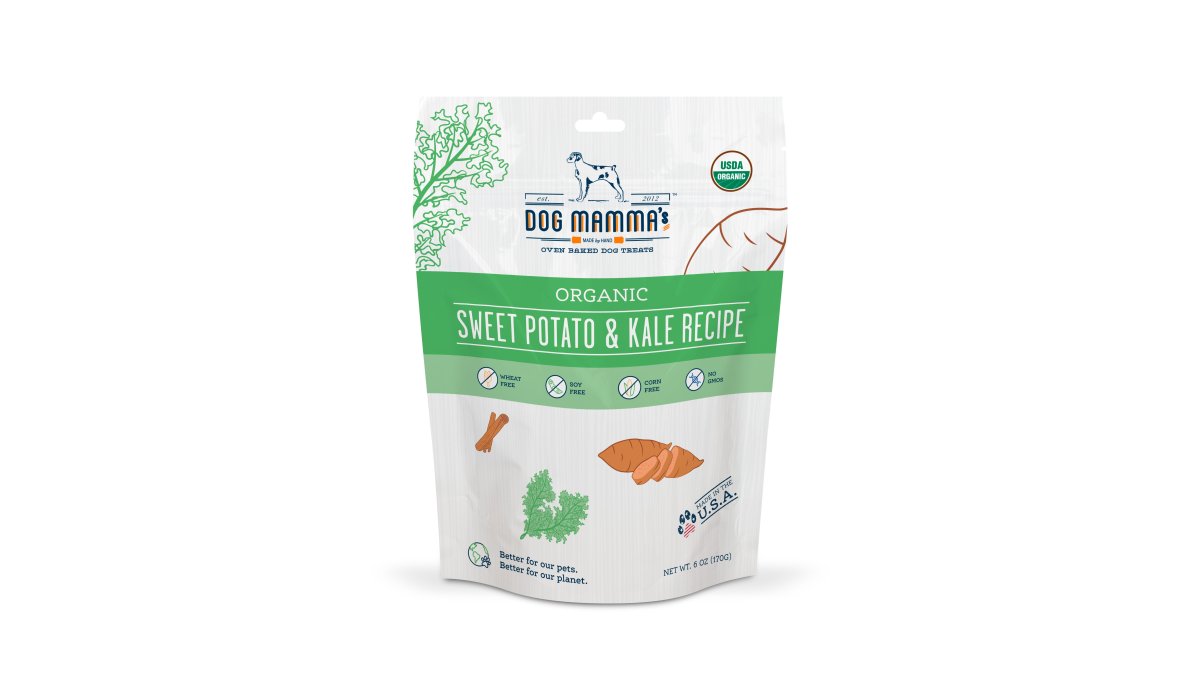
Sweet potato and kale make this the most nutrient-dense recipe in our lineup. The treats pack visible pieces of dark leafy organic kale alongside organic sweet potato, and the 6 oz bag costs $10.49.
Sweet potato gives natural sweetness and a satisfying crunch, while kale adds dark leafy nutrition that's hard to find in a dog treat, which is why we think of this recipe as the everyday wellness option rather than a pure reward.
For dogs on a limited-ingredient diet, this recipe keeps the panel short while still delivering more than empty calories. That's the balance most treat brands miss.
5. Dog Mamma's Organic Apple Cranberry Recipe
Organic apples, tart organic cranberries, and a dash of organic cinnamon give this recipe a flavor close to homemade apple pie. It ships in a 6 oz bag at $10.49.
Cranberries are familiar to pet parents watching urinary tract health, and apples add natural sweetness without added sugar. The cinnamon is a warm finishing note, not a dominant flavor.
This is our pick for picky eaters: the tart-sweet combination wins over dogs that ignore plainer treats, and the crunch keeps it valuable as a training reward.
Why Organic Dog Treats Are Worth the Investment
Organic dog treats cost more because certified organic ingredients cost more to grow, document, and inspect. The premium buys a pesticide-free supply chain, non-GMO inputs, and third-party-verified production.
Cost per ounce. A 6 oz bag at $10.49 works out to about $1.75 per ounce.
What you are actually paying for. The premium covers three things a cheap bag does not: certified organic ingredients, a shorter and more traceable supply chain, and small-batch production that avoids overstock waste. For dogs with sensitivities or allergies, a short list of certified organic ingredients makes it far easier to isolate what works, potentially saving the cost of an elimination diet trial or repeated vet visits.
Packaging end-of-life. This is where the eco math gets uncomfortable: a recyclable or compostable bag only delivers its benefit if your local waste system accepts it. Store drop-off film programs are common but not universal, and industrial compostable films are rarely accepted curbside.
Shipping footprint. Where a treat ships from matters as much as what's in it. A brand that manufactures and fulfills from a single regional facility generates fewer transport miles than one shipping finished goods across the country from a central warehouse.
How to decide. Run the rubric above on the bag you're considering. If it scores well on certification and sourcing and your local waste program accepts the packaging, the premium is doing real work.
The FDA guidance on pet food labeling explains what manufacturers may and may not claim on a pet treat label, which helps you spot the difference between a regulated term like organic and an unregulated one like natural. The EPA information on pesticide use outlines how conventional pesticides are regulated and why reducing exposure matters for both pets and the environment.
Frequently Asked Questions
What makes a dog treat brand eco-friendly?
An eco-friendly dog treat brand prioritizes sustainable sourcing, organic ingredients, and reduced environmental impact throughout production. Look for USDA Organic certification, plant-based or alternative proteins, upcycled ingredients, and plastic-free or compostable packaging. Brands that publish ingredient sourcing details and third-party certifications demonstrate real accountability rather than vague 'natural' claims. Small-batch production also reduces waste compared to mass manufacturing.
Are organic dog treats better for the environment?
USDA Organic certification prohibits synthetic pesticides and fertilizers, which reduces chemical runoff into soil and waterways. Organic farming practices often support healthier soil and lower carbon emissions compared to conventional agriculture. However, organic doesn't automatically mean low-impact packaging or local sourcing. The most sustainable organic dog treats combine certified organic ingredients with eco-friendly packaging and transparent supply chains.
What should I look for in sustainable dog treat packaging?
Prioritize plastic-free packaging that is recyclable or compostable. Look for brands that use recycled paper, biodegradable bags, or minimal outer wrapping. Packaging end-of-life matters: a treat bag that breaks down in home compost reduces landfill waste significantly. If a brand uses plastic, check whether it offers a take-back program or uses post-consumer recycled content. Transparency about packaging materials is a positive signal.
Are small-batch dog treats better for dogs?
Small-batch production allows tighter quality control, fresher ingredients, and less risk of cross-contamination. Small-batch dog treats are often made with human-grade ingredients and without artificial preservatives, since shorter production runs mean faster turnover. For dogs with food sensitivities, small-batch brands that publish full ingredient lists and certification details offer more transparency. The trade-off is typically higher cost per bag.
How can I tell whether dog treats are made with sustainable ingredients?
Check for third-party certifications like USDA Organic, which verifies organic farming practices. Look for named ingredients rather than generic terms like 'meat meal' or 'animal by-products.' Brands that disclose their supply chain, use upcycled ingredients, or source from regenerative farms provide verifiable sustainability signals. If a brand claims 'eco-friendly' without certification or sourcing details, treat that claim with skepticism.
Choosing treats for a dog with sensitivities means reading every label and hoping the claims hold up. Dog Mamma's removes that guesswork with USDA Organic Certification, human-grade plant-based ingredients, and small-batch handcrafted production you can trace. Every recipe is free from pesticides and GMOs, so you know exactly what's in the bag. Get started with Dog Mamma's and give your dog clean, sustainable nutrition you can feel good about.